






Ready to try BrandSKU?

AI dropshipping sounds like a magic button. Click it, and a store runs itself. The reality is more useful and less flashy.
AI tools handle the repetitive work — finding products, writing descriptions, tracking prices, answering support tickets — so you can focus on the parts that actually grow a store.
This guide breaks down how AI dropshipping really works in 2026, which tasks it handles well, and which ones still need you.
You'll also get a look at 10 of the best AI tools worth trying, what each one does, and how to fit them into your workflow without overspending.
What Is AI Dropshipping and How Does It Work?
What Is AI Dropshipping
AI dropshipping is regular dropshipping with software doing the parts you used to do by hand. You still don't hold inventory. You still list products, take orders, and pass them to a supplier who ships to your customer.
What changes is who picks the products, writes the descriptions, monitors the prices, and answers the late-night "where's my order" emails.
A quick note before we go further. AI doesn't run a store for you — it runs tasks inside a store. That distinction matters because it shapes what you should expect.
These tools handle the repetitive work: pulling product data, writing first drafts, tracking prices, sending order updates. That frees you up for the parts that actually move the needle — picking the right product, understanding your customer, and running ads that convert.
How It Works
Think of AI for dropshipping as a set of small jobs, each handled by a different piece of software. A typical setup covers five stages:
Finding products. Tools like Sell The Trend or Minea scan millions of ads, stores, and product listings to spot items gaining traction. Instead of scrolling AliExpress for hours, you get a shortlist of products with real sales data behind them.
Building the store. Platforms like Zendrop and Spocket can generate a starter store from a prompt — theme, product pages, copy, and a catalog. You still need to edit it, but you skip the blank-page problem.
Writing product content. AI generates product titles, descriptions, and ad copy from a supplier listing. Expect to rewrite about a third of it. The point isn't perfect copy; it's not starting from zero on every product.
Pricing and monitoring. Tools like Intelis AI track competitor prices on Google Shopping and adjust yours automatically. This is one of the few areas where AI genuinely runs on its own — prices change every hour, and no human wants to babysit that.
Fulfilling orders. When a customer buys, tools like AutoDS forward the order to the supplier, sync tracking numbers, and update the customer. If a supplier runs out of stock, the tool pulls the listing before more orders come in.
Most sellers who make this model work run two or three tools that each handle one stage, not one platform that claims to do it all. The next sections walk through which tools to pick and how to split the work between them.
10 Best AI Dropshipping Tools to Try in 2026
AutoDS
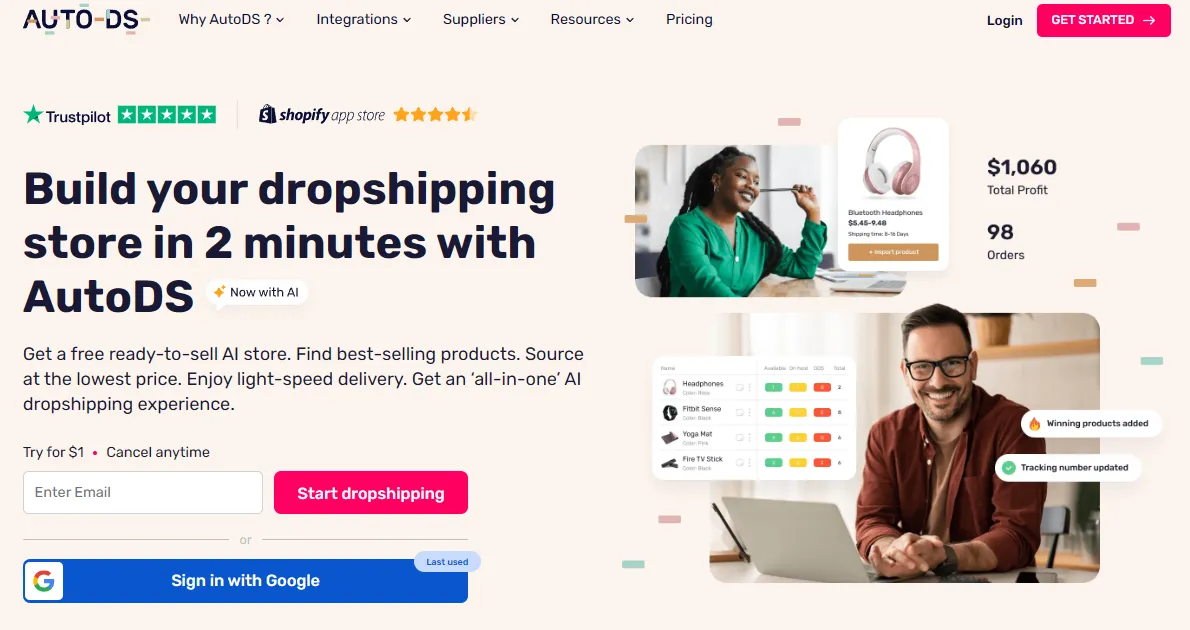
AutoDS is the closest thing to a full operations backend for dropshipping. Product imports from 25+ suppliers, automated order fulfillment, price and stock monitoring, an AI Store Builder, and an AI title/description generator all live in one dashboard.
The $1 trial lets you test the whole thing before committing. If you're outgrowing manual work and want one platform instead of five subscriptions, this is where most sellers land.
Spocket
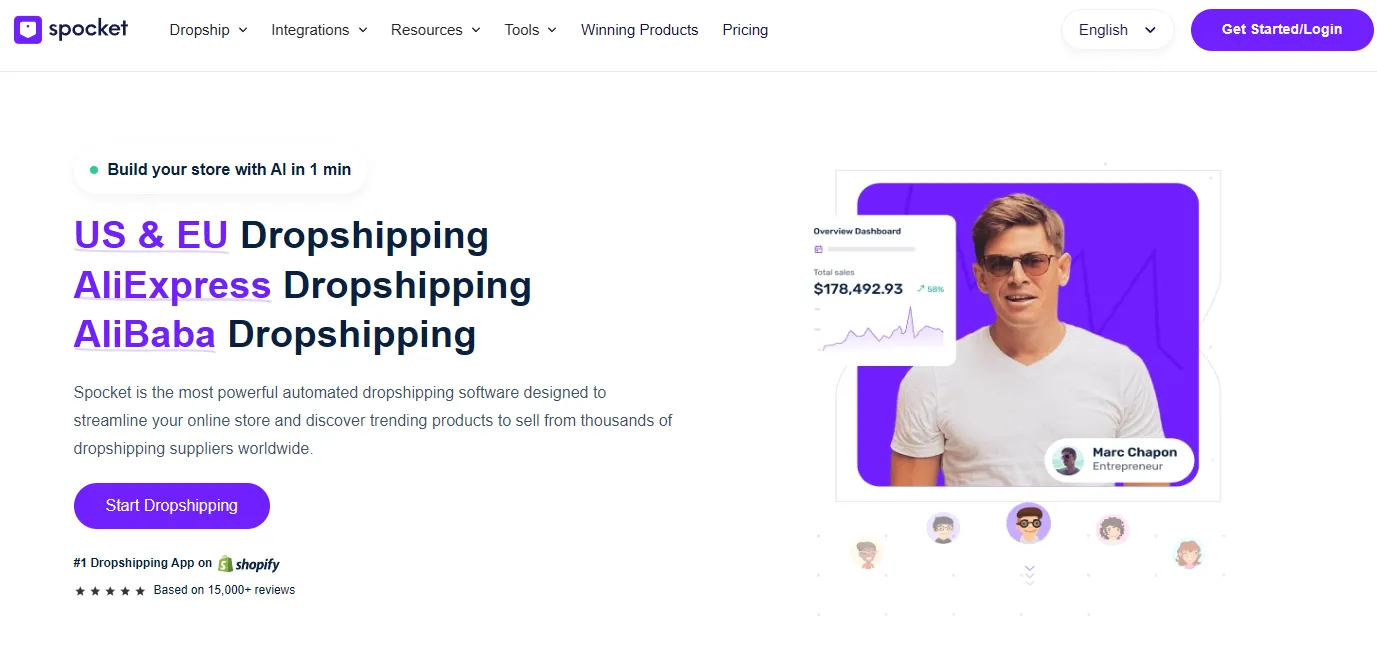
Spocket's edge is its supplier network — most warehouses sit in the US and EU, so shipping runs 2 to 7 days instead of the three-week AliExpress wait. That alone solves the biggest complaint dropshipping stores get.
Its AI store builder and Smart Dropshipping Bot are useful add-ons, but the reason to pick Spocket is delivery speed. Skip it if your margins depend on the cheapest possible sourcing.
Zendrop
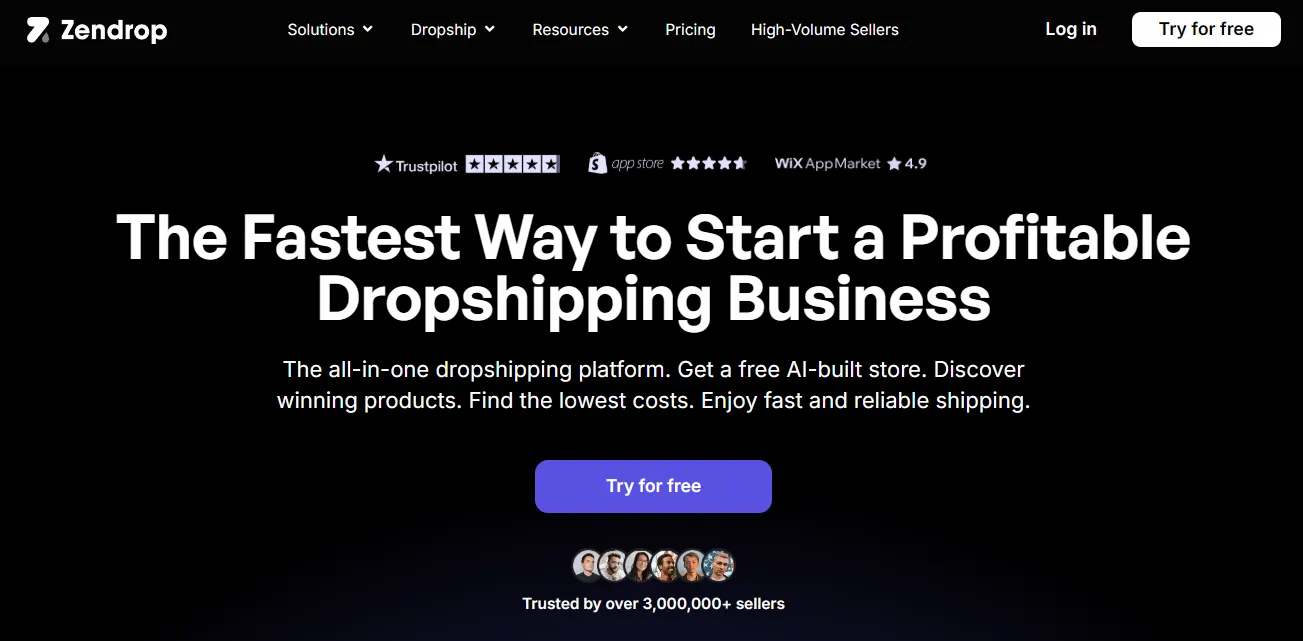
Zendrop does the standard sourcing-plus-fulfillment thing, but the 2026 upgrade worth paying attention to is its MCP Server. It lets ChatGPT or Claude connect directly to your store — you can ask an AI assistant to check orders, pull analytics, or trigger fulfillment through natural chat.
No other platform on this list does that yet. Add in the AI Ad Generator for TikTok-style video creative, and it's the most forward-looking pick here.
Sell The Trend
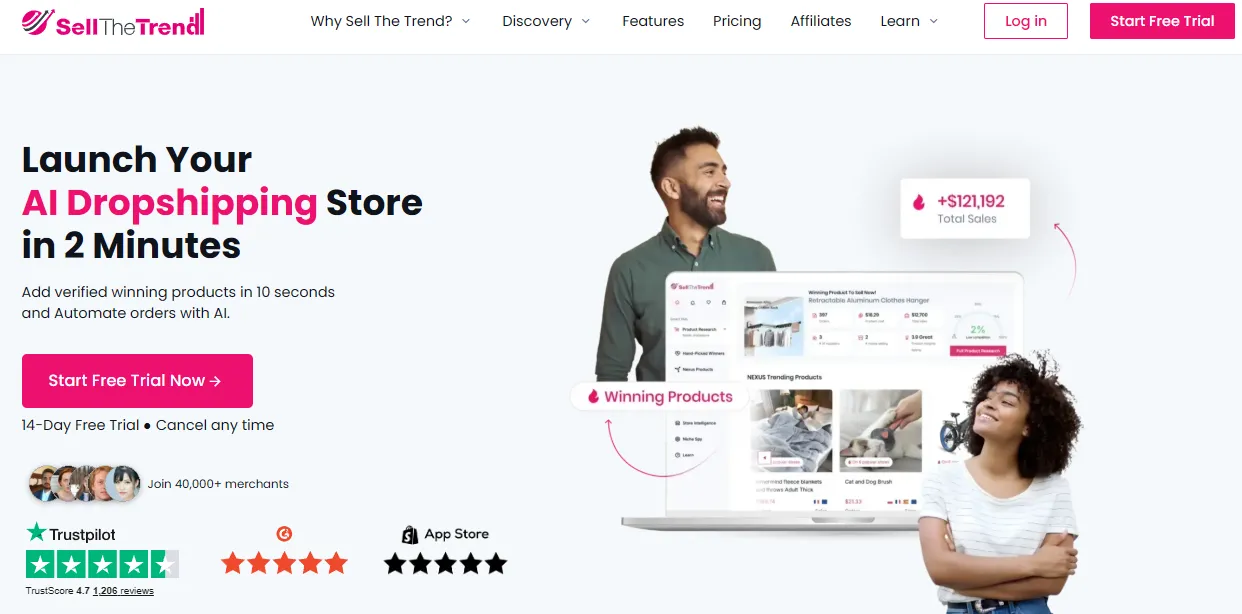
Sell The Trend's NEXUS engine evaluates 26 data points per product across AliExpress, Amazon, TikTok, and Meta, cross-referencing sales signals so you don't waste budget on saturated trends.
That triangulation is the real value — most spy tools show you what's popular, NEXUS shows you what's popular and still has room to run. Pick this if product research is where you keep getting stuck.
Dropship.io
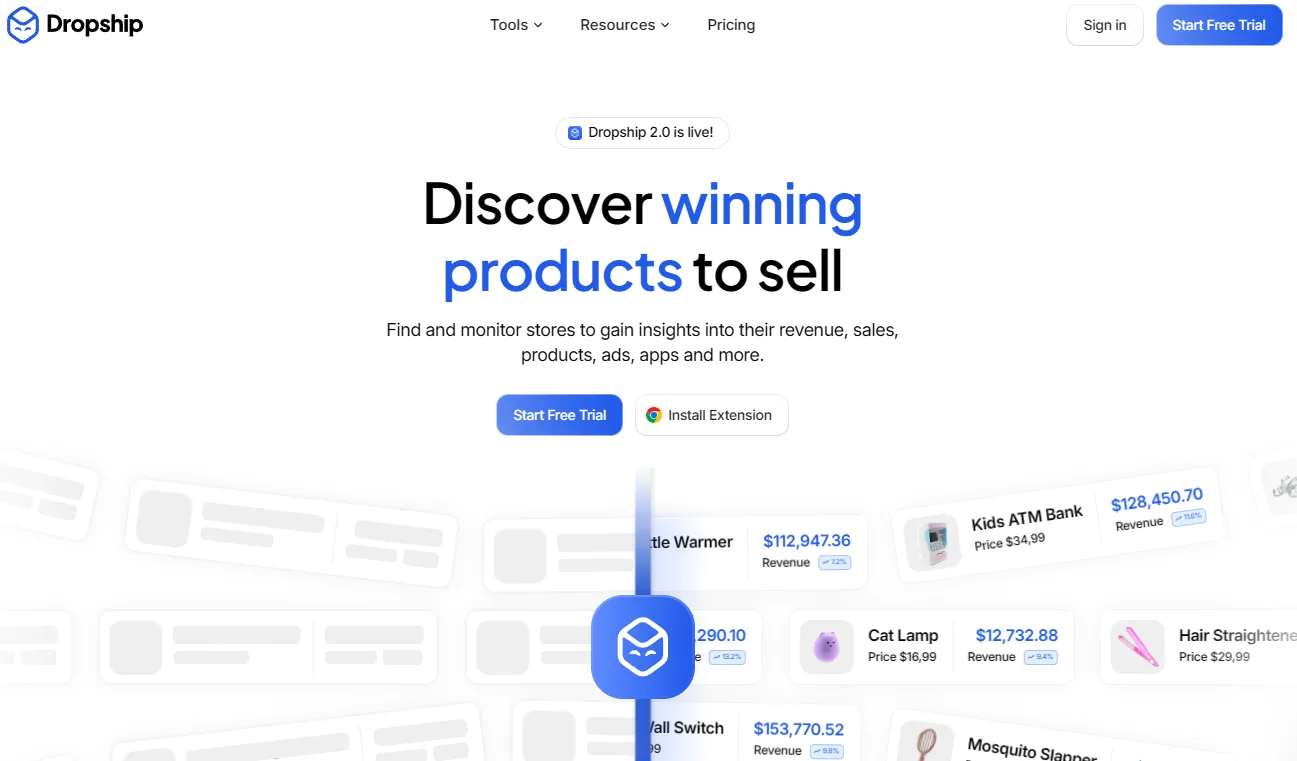
Dropship.io is a competitor lens, not a sourcing tool. It tracks real Shopify stores, shows you their estimated revenue, which products are climbing, and which ads they're running.
It won't fulfill orders or build a store for you. What it will do is tell you whether a product idea is already being milked by five stores doing $50K a month — and that's a decision worth $39 a month before you spend a cent on ads.
Minea
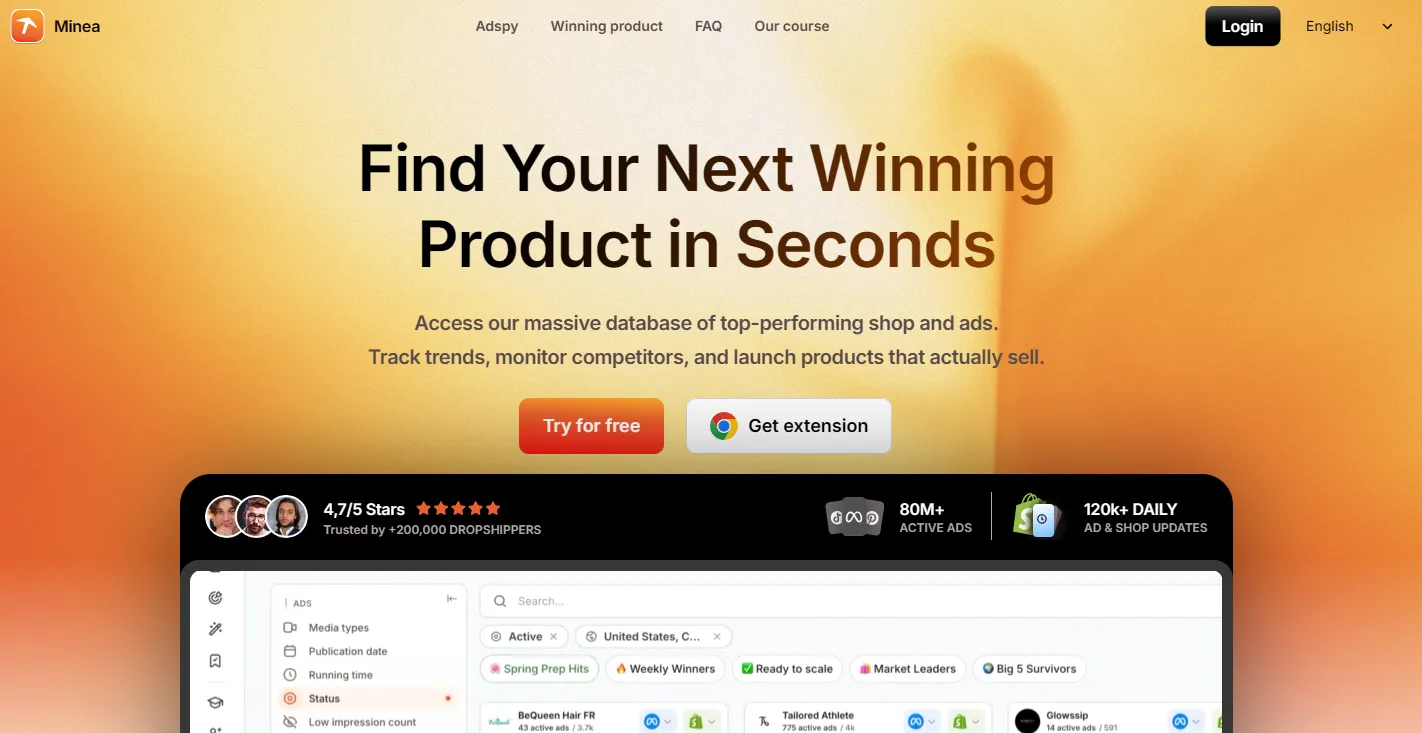
Minea watches over 80 million ads across Meta, TikTok, and Pinterest, with AI analysis breaking down what makes winning creatives work.
The Success Radar refreshes the top 100 trending products every eight hours, which matters because trends peak fast in 2026. If you validate products through ad engagement rather than store data, Minea beats every research tool that leans on Shopify signals alone.
PPSPY
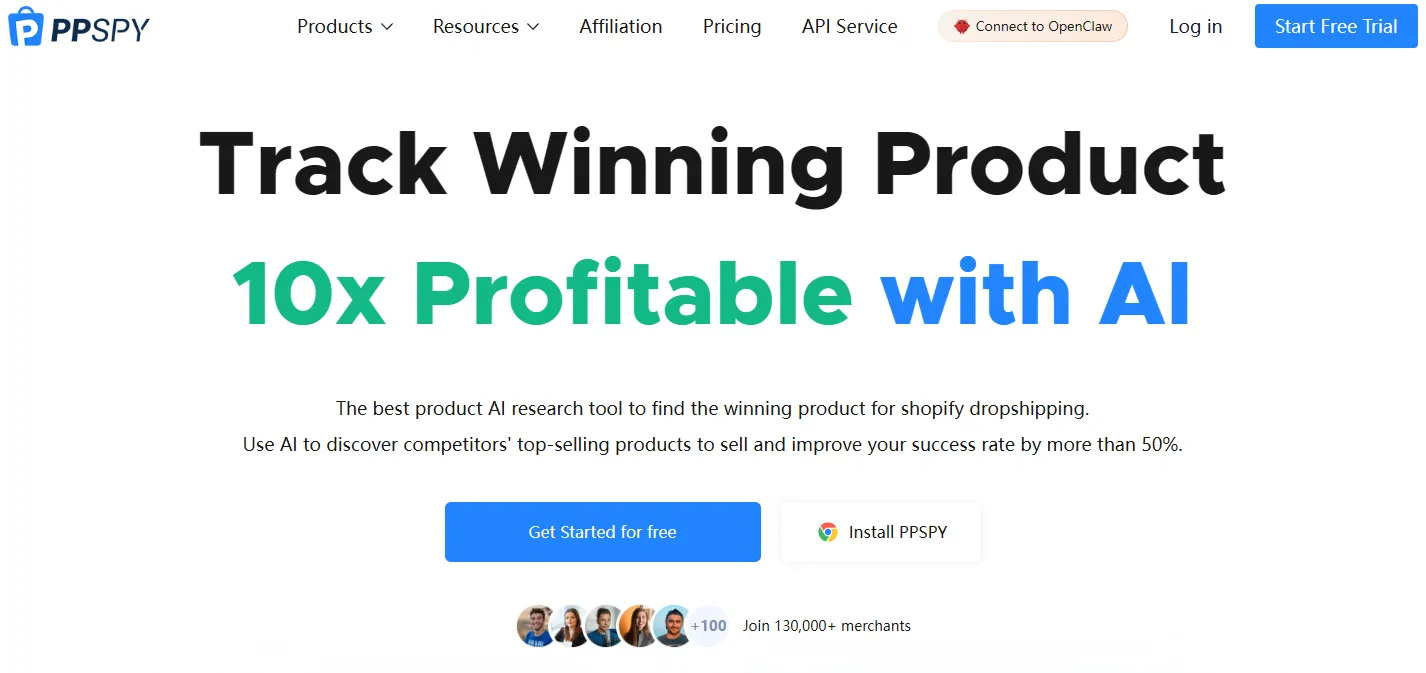
PPSPY goes deeper into individual Shopify stores than Dropship.io does. You see traffic sources, installed apps, product add/remove history, and AI-predicted order volume.
It's the tool sellers use to reverse-engineer a competitor's full funnel, not just spot their bestsellers. Best paired with an ad-spy tool like Minea, since PPSPY only covers the store side of the equation.
Tidio
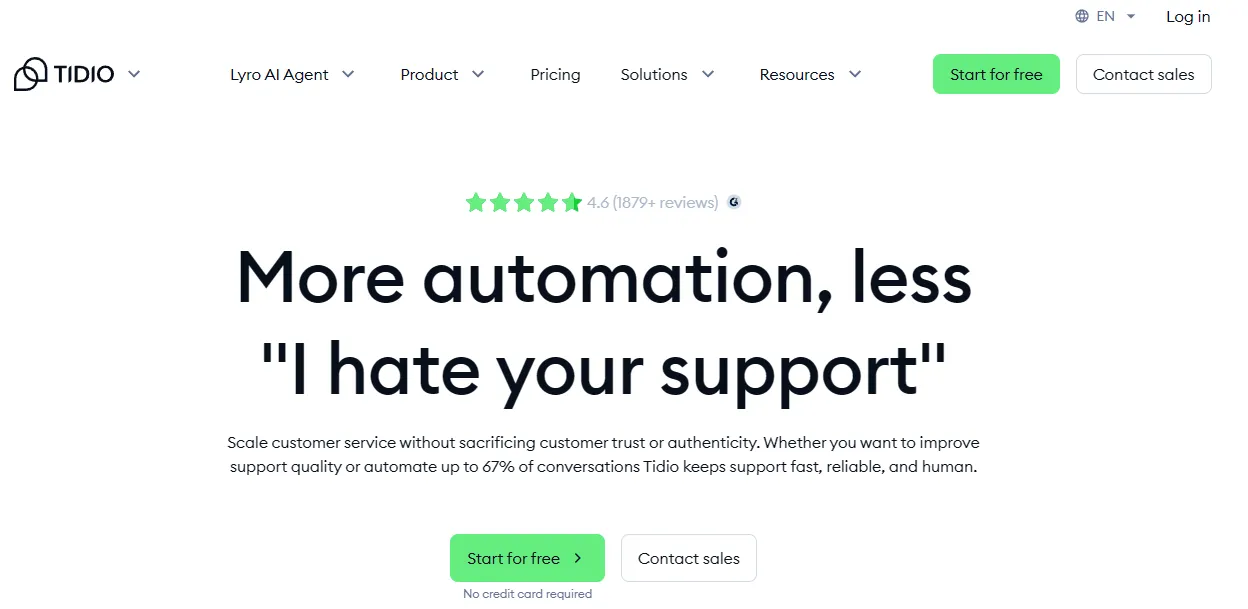
Tidio's AI chatbot handles the questions that eat 80% of a dropshipping store's support time: where's my order, how do returns work, is this still in stock.
It hands off to a human when the question gets complex. Direct Shopify integration means the bot can actually pull order data instead of giving generic answers. Worth adding the moment your inbox starts feeling like a second job.
Jasper
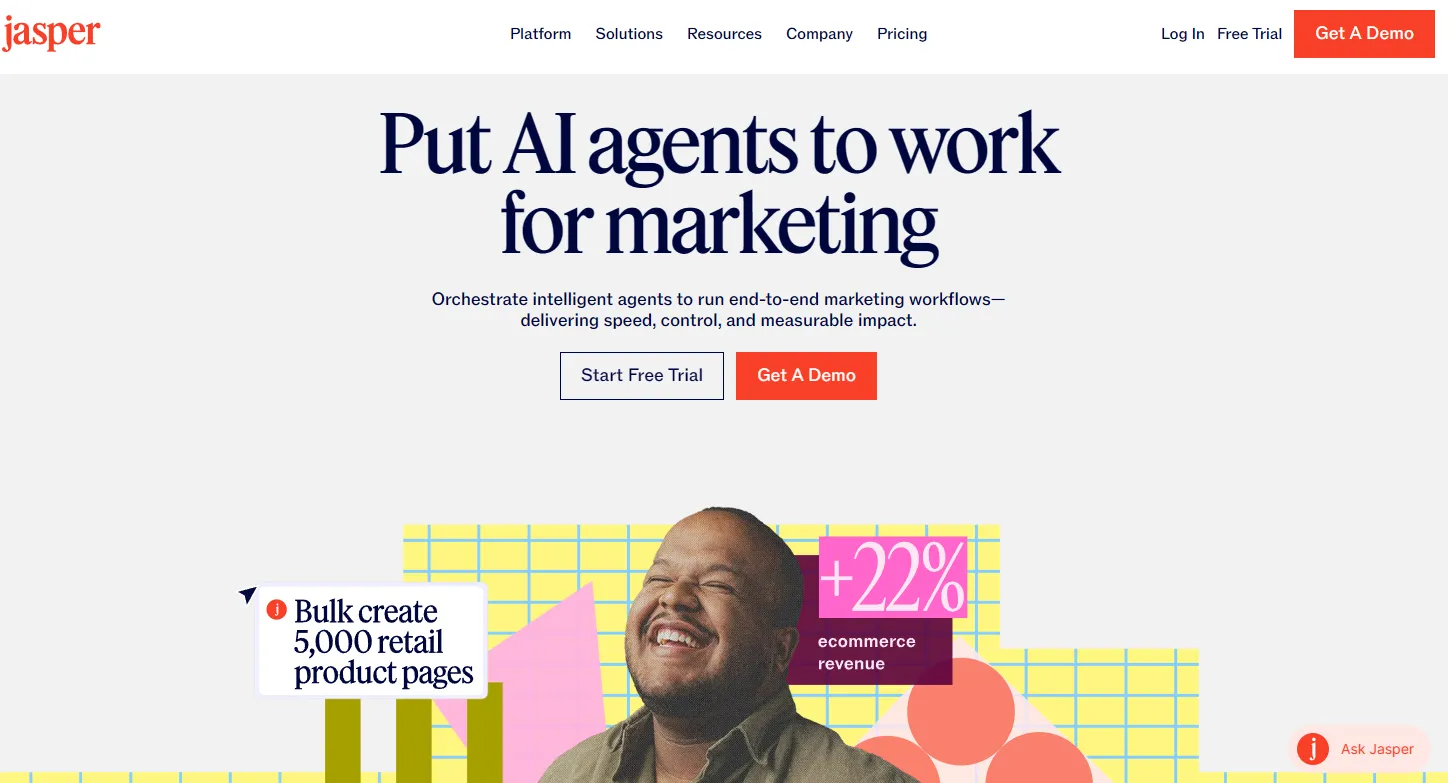
Jasper isn't dropshipping-specific, but it's the AI writing tool most operators actually pay for. Product descriptions, ad copy, email flows, blog content — all generated from short prompts, with a brand voice setting that keeps output consistent across a catalog.
If you launch new products weekly, the time savings compound fast. If you launch a handful per month, ChatGPT probably does the same job for less.
Gorgias
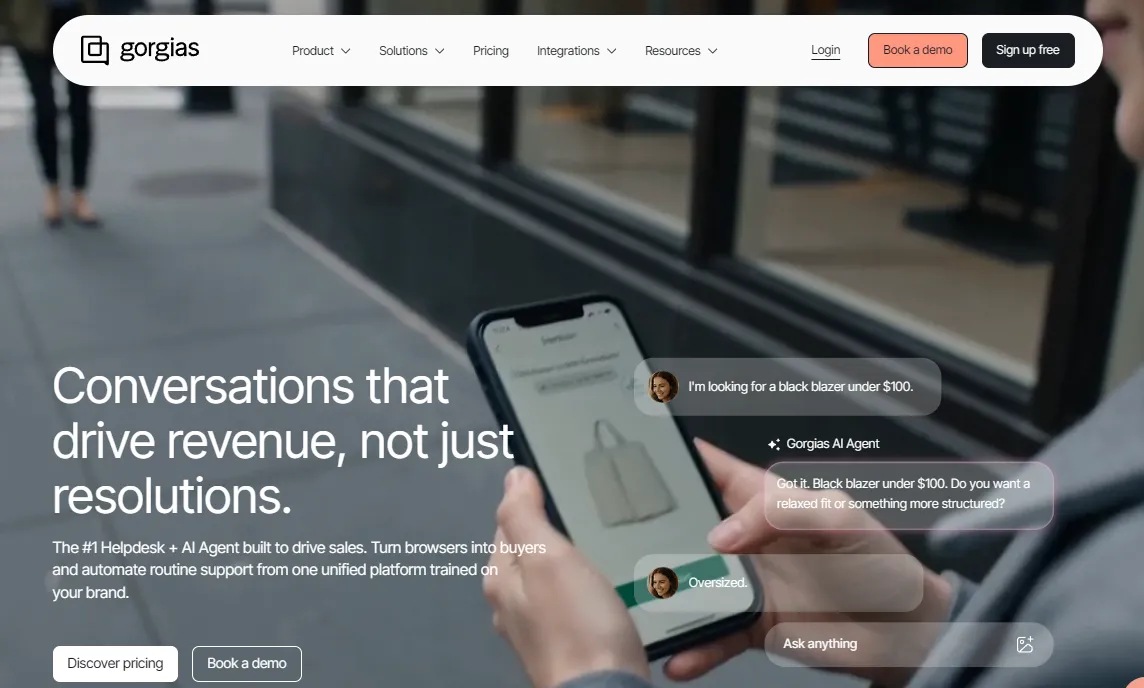
Gorgias is Shopify-first customer support, built by people who understand how ecommerce tickets differ from generic SaaS support.
Its AI can auto-resolve shipping, return, and product questions by pulling live order data into every reply. The pricing gets steep, so this makes sense once you're past a few hundred orders a month. Below that, Tidio does enough at a lower cost.
How to Assign Tasks to the Right AI Tools
The biggest mistake new sellers make isn't picking the wrong AI tool — it's expecting one tool to do everything. Sellers who make this work treat AI tools like specialists. Each tool gets one job, and the jobs connect into a workflow.
Match One Tool to One Bottleneck
Start with the task eating the most hours of your week. Three hours a day scrolling supplier catalogs? That's a research problem. Refreshing competitor prices in a spreadsheet?
Pricing. Inbox full of "where's my order" questions? Support.
Pick one tool to fix that one bottleneck first. Not a bundle. Not an all-in-one. Sellers who've made dropshipping AI tools work almost all started the same way: one problem, one tool, then added a second later.
Let AI Handle Repetitive Work, Not Judgment Calls
AI is reliable for repetitive tasks with clear inputs — checking competitor prices, generating product descriptions, forwarding orders, answering the same shipping question for the hundredth time.
AI is unreliable for judgment calls. Which product will resonate with your audience. Whether an ad angle feels off. When to drop a slipping supplier. Automate the first bucket. Protect the second.
Split Research From Execution
Research tools like Sell The Trend or Minea find signals — what's trending, what's converting. Execution tools like AutoDS or Zendrop run the operational back end — imports, fulfillment, inventory syncing.
Using a research tool for execution leaves you with data and no way to act on it. Using an execution platform for research leaves you fulfilling orders for products that won't sell. Buy for the layer you need most right now.
Avoid Buying Tools That Overlap
If two tools do the same job, you're paying twice. This happens most with pricing and fulfillment — sellers subscribe to AutoDS, then add a second price monitor, not realizing AutoDS already does it.
Before adding a tool, list what your current stack already covers. Then check whether the new tool fills a gap or repackages something you have.
Start Small, Expand Only When Something Breaks
A working setup rarely starts with five tools. It starts with one or two, run until the seller hits the next real limitation — usually a few hundred orders a month, when support or fulfillment outgrow manual work.
That's the signal to add the next tool. Adding ahead of the pain point creates complexity without benefit.
How to Check AI Output Before Using It
AI moves fast, but speed isn't the same as accuracy. Before any AI-generated output goes live in your store, it needs a second look. A product recommendation, a description, a price change — each one can look reasonable on the surface and still be wrong underneath.
Check the Data, Not Just the Suggestion
When a tool recommends a "winning product," don't stop at the score. Look at the 30-day sales trend, how many competitors already run it, and whether demand is climbing or fading.
AI surfaces patterns, but it doesn't know how saturated your niche already is.
Rewrite AI Copy Before Publishing
AI-generated descriptions and ad copy tend to sound generic — they read the same across every product.
Rewrite the opening line, fix any wrong specs pulled from supplier data, and cut phrases that could apply to anything. The goal isn't perfect copy; it's copy that sounds like your store, not like a template.
Spot-Check Automated Actions
Automated pricing and fulfillment run in the background, which is why they're worth auditing weekly.
Pull a random sample — five recent price changes, five recent orders — and check whether the tool did what you'd have done manually. Small errors compound quickly when nothing is watching.

How Much Revenue Covers Your AI Tool Costs?
Most articles list AI tools without mentioning what they cost together. Stack a store builder, a product scraper, an ad spy, a chatbot, and a copywriter, and you're looking at $150 to $400 a month in subscriptions before you spend a single dollar on ads.
That's the number to plan around — not the individual tool prices.
Add Up the Real Monthly Overhead
A typical AI dropshipping stack in 2026 looks something like this:
- AutoDS — $20–$66
- Minea — $49–$99
- Sell The Trend — $30–$100
- Tidio (chatbot) — $25–$60
- Writing tool — $25–$40
That's roughly $150 on the low end and $365 on the high end. Add Shopify at $39 and a domain, and you're at $200–$400 before your first sale.
This isn't a reason to skip AI tools — it's a reason to know your number before you subscribe.
Calculate Your Break-Even Revenue
Dropshipping margins usually sit at 15% to 30% after product cost and shipping. At a 20% margin, covering $300 in monthly software costs takes $1,500 in revenue. Not profit — revenue, just to zero out the software bill.
Add ad spend at 20% to 30% of revenue on top of that, and the math shifts fast. A store doing $3,000 a month with a 20% margin and 25% ad spend is barely breaking even after tools. That's the trap most beginner guides skip.
Match Your Stack to Your Stage
If you're testing your first product, you don't need a $400 stack. A minimal setup — Shopify plus AutoDS's $1 trial plus ChatGPT — gets you started for under $50 a month. Add tools only when a specific bottleneck justifies the cost.
Once you're consistently past $5,000 in monthly revenue, the full stack starts paying for itself. Below that, extra tools eat margin you don't have yet. Scale your subscriptions to your revenue, not to what the "best tools" list says you need.
Expert Tips
AI dropshipping works best when you treat it as a set of tools, not a shortcut. Each tool has one job. Your job is to pick the right ones for your stage, check what they output, and scale your stack as your revenue grows.
Start small. Fix one bottleneck at a time. Add the next tool only when a real problem asks for it. The sellers who make this model work aren't the ones with the biggest stack — they're the ones who match their tools to their goals.
Pick a starting point today, and build from there.
FAQs
Is AI dropshipping legal?
Yes. AI tools are just software that helps you run tasks faster. As long as your products, suppliers, and tax setup follow the rules in your region, using AI changes nothing legally.
Can AI fully automate dropshipping?
Not really. AI handles the repetitive parts well — pricing, order routing, basic support. Product choices, brand voice, and ad strategy still need your judgment. Expect help, not a hands-off business.
What are the best AI tools for dropshipping?
It depends on your bottleneck. AutoDS and Zendrop cover fulfillment. Sell The Trend and Minea handle research. Tidio and Gorgias run support. Pick based on the problem you need solved first.
Is automated dropshipping profitable?
It can be, but automation alone won't make a store profitable. Margins come from smart product picks, tight ad spend, and steady operations. AI just removes the manual work slowing you down.
What percent of dropshippers fail?
Estimates suggest around 80% to 90% of new stores don't reach steady profit. Most quit early, pick saturated products, or underestimate ad costs. Patience and testing separate the ones who last.
Share article


Written by

Online retail background | Covers dropshipping and suppliers | Writing about the daily grind of running a small store

 Early access

